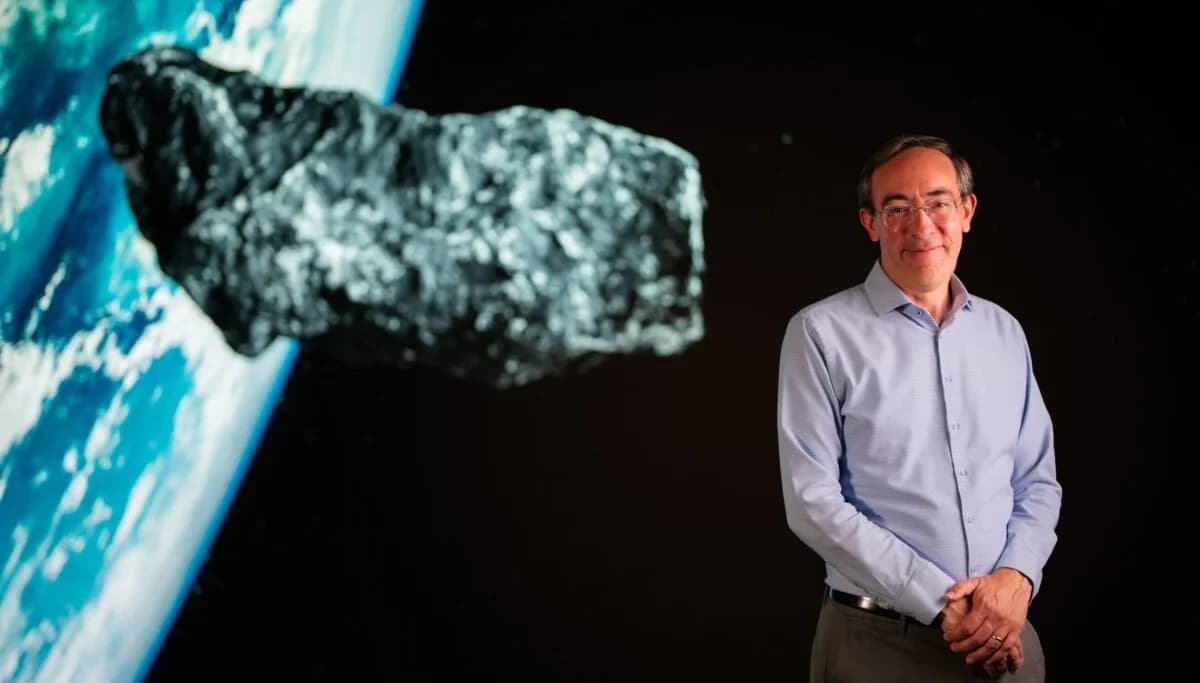
Researchers at Sandia National Laboratories in the US have developed a faster and more detailed way to model how asteroids could be pushed off their trajectories, The Register reports. A team led by physicist Nathan Moore studied how X-rays from a nuclear explosion near an asteroid change the direction of its motion.
Because earlier calculations took so long, scientists typically modelled asteroids as spheres and simplified the physics. The new approach combines two codes used at the laboratory: ALEGRA, which models radiation heating and the dynamics of high-density matter, and SPARTA, which simulates the behaviour of low-density gases. The method is more than 1,600 times faster than previous ones while keeping enough accuracy for irregularly shaped asteroids.
The team ran simulations on detailed models of the asteroids Golevka, Bennu and Itokawa. They found that irradiating different sides of the same asteroid could produce up to a fivefold difference in the resulting change in velocity. Even on Bennu, the most symmetrical of the three, the difference was about twofold. "We expected aiming to matter, what surprised us was how much it mattered," Moore said.
The researchers noted that information about a dangerous asteroid may be scarce and there may not be time to study it closely. An asteroid's composition, internal structure and orientation also make predictions harder.
Most real asteroids are far from perfect spheres, which is why earlier models could not fully capture how they would behave when struck by the energy of a nearby nuclear blast.
Source: The Register
Next story